| CUDA_version | ||
| Dictionary | ||
| Images | ||
| OpenCL_version | ||
| build.sh | ||
| LICENSE | ||
| README.md | ||
| run.sh | ||

Bitcracker
BitCracker is the first open source BitLocker password cracker tool
Introduction
BitLocker is a full-disk encryption feature available in recent Windows versions (Vista, 7, 8.1 and 10) Pro and Enterprise. BitCracker is a mono-GPU password cracking tool for memory units encrypted with the password authentication mode of BitLocker (see picture below).
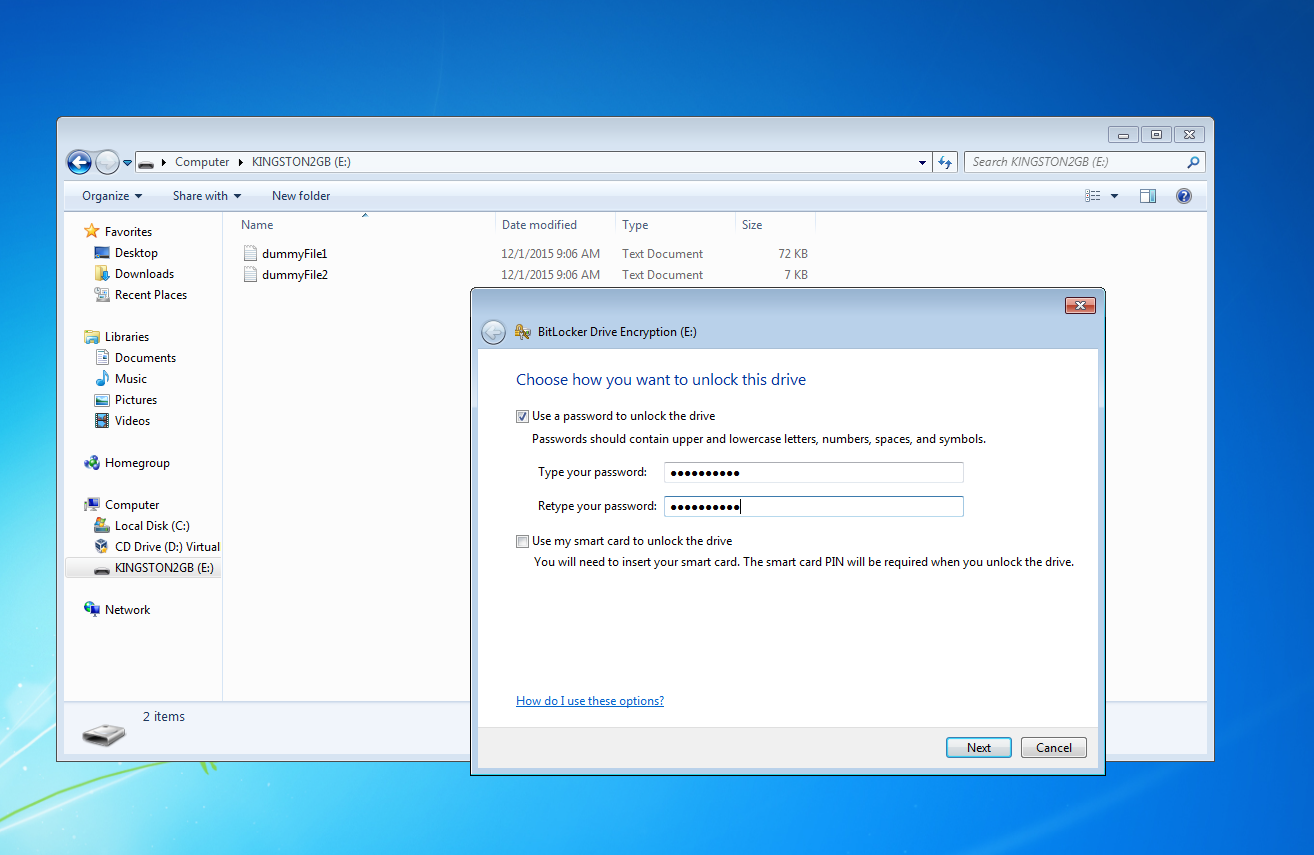
Our attack has been tested on several memory units encrypted with BitLocker running on Windows 7, Window 8.1 and Windows 10 (both compatible and non-compatible mode). here we present two implementations: CUDA and OpenCL.
Requirements
For CUDA implementation, you need at least CUDA 7.5 and an NVIDIA GPU with minimum cc3.5 (i.e. Kepler arch)
How To
Use the buil.sh script to run makefiles within CUDA_version and OpenCL_version.
> ./bitcracker_cuda -h

Usage: ./bitcracker_cuda -i <disk_image> -d <dictionary_file>

Options:

  -h, --help				Show this help
  -i, --diskimage			Path to your disk image
  -d, --dictionary file		Path to dictionary or alphabet file
  -g, --gpu					GPU device number
  -t, --passthread			Set the number of password per thread threads
  -b, --blocks				Set the number of blocks
You can use the run.sh script to execute two simple runs using the encrypted images we provide in this repo: - imgWin8: memory unit encrypted with BitLocker using a Windows 8 Enteprise edition OS - imgWin7: memory unit encrypted with BitLocker using a Windows 7 Enteprise edition OS
Currently, BitCracker is able to evaluate passwords having length between 8 (minimum password length) and 16 characters (implementation reasons). We will increase the max passwords size in the next release. BitCracker doesn't provide any mask attack, cache mechanism or smart dictionary creation; thus you need to provide your own input dictionary.
Performance
Here we report best performance of BitCracker implementations tested on different GPUs
| GPU Acronim | GPU | Arch | CC | # SM | Clock | CUDA |
|---|---|---|---|---|---|---|
| GFT | GeForce Titan | Kepler | 3.5 | 14 | 835 | 7.0 |
| GTK80 | Tesla K80 | Kepler | 3.5 | 13 | 875 | 7.5 |
| GFTX | GeForce Titan X | Maxwell | 5.2 | 24 | 1001 | 7.5 |
| GTP100 | Telsa P100 | Pascal | 6.1 | 56 | 1328 | 8.0 |
| AMDM | Radedon Malta | - | - | - | - | - |
Performance:
| Version | GPU | -t | -b | Passwords x kernel | Passwords/sec | Hash/sec |
|---|---|---|---|---|---|---|
| CUDA | GFT | 8 | 13 | 106.496 | 303 | 635 MH/s |
| CUDA | GTK80 | 8 | 14 | 114.688 | 370 | 775 MH/s |
| CUDA | GFTX | 8 | 24 | 106.608 | 933 | 1.957 MH/s |
| CUDA | GTP100 | 8 | 56 | 458.752 | 1.363 | 2.858 MH/s |
| OpenCL | AMDM | 32 | 64 | 524.288 | 241 | 505 MH/s |
| OpenCL | GFTX | 8 | 24 | 196.608 | 884 | 1.853 MH/s |
John The Ripper
We released the OpenCL version as a plugin of the John The Ripper (bleeding jumbo) suite.
http://openwall.info/wiki/john/OpenCL-BitLocker
References, credits and contacts
This is a research project in collaboration with the National Research Council of Italy released under GPLv2 license. Copyright (C) 2013-2017 Elena Ago and Massimo Bernaschi We will provide some additional info about BitCracker's attack in a future paper.
For any additional info, start a collaboration or to report any bug please contact